2026 Multi-Hazard Mitigation Plan
- View the 2026 Pulaski County Multi-Hazard Mitigation Plan (M.-H.M.P.) here.
- View Exhibit 1 to the 2026 Pulaski County M.-H.M.P., the Critical and Essential Facilities Map, Vhere.
- View Exhibit 2 to the 2026 Pulaski County M.-H.M.P., the Pulaski County Flood Map, here.
- View Exhibit 3 to the 2026 Pulaski County M.-H.M.P., the Historical and Hypothetical Tornado Map, here.
- View the Appendices to the 2026 Pulaski County M.-H.M.P. here.
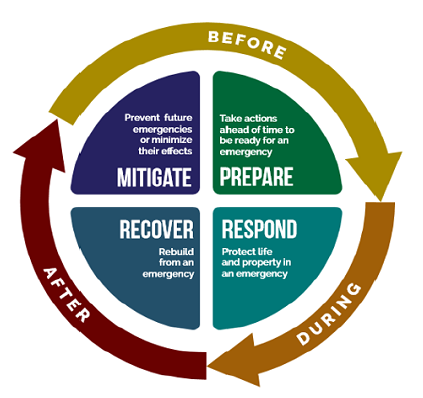
The Federal Emergency Management Agency (FEMA) defines the disaster life cycle as the process through which emergency managers respond to disasters when they occur; help people and institutions recover from them; reduce the risk of future losses; and prepare for emergencies and disasters. [There are four phases] in the Emergency Management Lifecycle; Mitigate, Prepare, Respond, and Recover…. Although each of the phases is visually tied to a specific time period within the life cycle of the disaster, mitigation can take place throughout much of the disaster life cycle. The Pulaski County Multi-Hazard Mitigation Plan (M.-H.M.P.) update focuses on the mitigation activities that may be implemented throughout the disaster life cycle.
According to FEMA, mitigation is most effective when it is based on an inclusive, comprehensive, long-term plan that is developed before a disaster occurs. The M.-H.M.P. planning process identifies hazards, the extent that they affect the municipality, and formulates mitigation practices to ultimately reduce the social, physical, and economic impact of the hazards.
The overall goals of the Pulaski County M.-H.M.P., which align closely with the State of Indiana M.-H.M.P., are:
- Lessen the impacts of disasters and enhance community resilience
- Minimize the loss of life and injuries caused by disasters
- Promote mitigation activities both prior to and following a disaster
To achieve the stated goals the community strategy includes the following:
1. Lessen the impacts of disasters and enhance community resilience by:
a. Supporting resilience opportunities within the community
b. Incorporating the MHMP into local ordinances, local planning efforts, and the community comprehensive plans
c. Evaluating and strengthening collaboration among organizations
d. Making sure critical and essential facilities can withstand disasters
e. Supporting the National Flood Insurance Program (NFIP)
f. Identifying opportunities to reduce repetitive loss incidents
2. Minimize the loss of life and injuries caused by disasters by:
a. Improving warning systems for the residents
b. Developing public awareness and outreach programs
c. Improving shelter availability
d. Developing a program of affordable housing that is resilient to flooding
e. Improving education and training for emergency personnel and officials
f. Developing ways to provide education, awareness, and warning of disasters to all members of the community
3. Promote mitigation activities prior to and following a disaster by:
a. Ensuring better communication between federal, state, and local officials
b. Seizing opportunities to buy out properties, floodproof buildings, or improve building codes
c. Conducting new studies or research opportunities to reduce impacts from disasters and prepare for future events anticipating the impacts of our changing climate
d. Conducting outreach efforts to educate community members about the risks and hazards in their area as well as encouraging the implementation of a variety of mitigation actions
For NFIP communities to be eligible for future mitigation funds, they must either adopt their own M.-H.M.P. or participate in the development of a multi-jurisdictional MHMP. Further, it is required that local jurisdictions review, revise, and resubmit the MHMP every five years. The following are the incorporated communities that have provided information, attended meetings, and participated in the planning process, the planning process used to update the Pulaski County M.-H.M.P. satisfies the requirements of a multi-jurisdictional plan: Pulaski County; Town of Francesville; Town of Medaryville; Town of Monterey; and Town of Winamac.
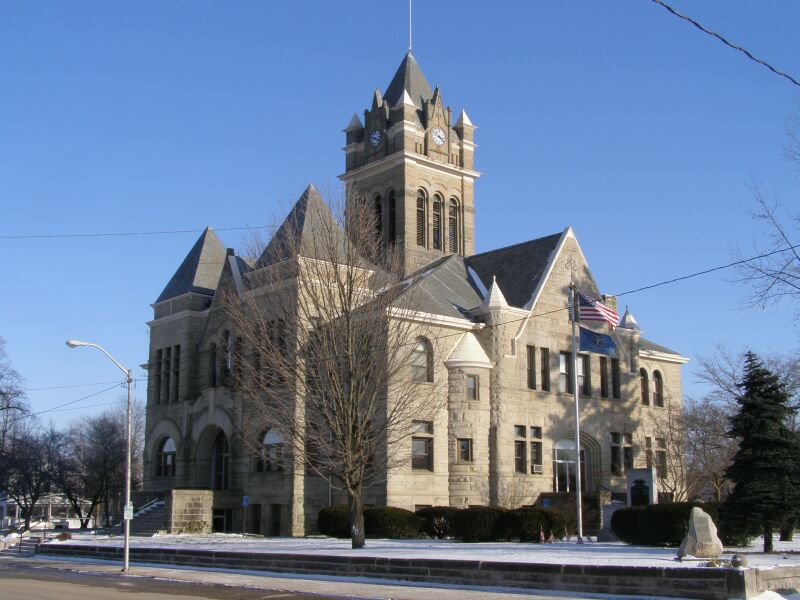
Pulaski County Courthouse
Social Links
Site Links